
We have been fortunate to visit Opus One many times over the years, and it has never once felt routine. The turn off Highway 29 in Oakville, the long drive, the low limestone crescent rising out of its grassed berm, the first bars of classical music as you step into the hall: the welcome is the same every time, and so is the sense of having arrived somewhere that takes itself seriously without ever saying so.
It is a property we return to, and send clients to, because it manages something rare in Napa: it is at once the valley’s most famous address and one of its most composed. What follows is less a review than a collection of what we have learned there, visit by visit.
A Baron and a Californian
Opus One began as a handshake between two men who believed Napa could make a first-growth wine long before anyone else did. Baron Philippe de Rothschild, owner of Château Mouton Rothschild, and Robert Mondavi first met in 1970 at the Mauna Kea Beach Hotel in Hawaii. The idea of a joint venture took shape over the decade that followed, and the agreement was finally sealed in 1978.
The first vintage was made in 1979 in a corner of the Robert Mondavi Winery, by Tim Mondavi and Mouton’s winemaker Lucien Sionneau, and the venture was announced to the world in 1980. The partners had been calling the wine “Opus”; it was the Baron who, a few days later, suggested lengthening it to Opus One. The 1979 and 1980 vintages were released together in 1984, at a price nobody in California had yet dared to ask for a Cabernet.
The partnership has outlived both founders. When Constellation Brands bought the Mondavi company in 2004, the Rothschild family negotiated to keep Opus One a 50/50 venture with its own team and its own independence, and that is how it is run today, with Michael Silacci in sole charge of the winemaking since 2004. It remains, half a century on, the most successful marriage of Bordeaux and Napa ever attempted.
On To Kalon ground
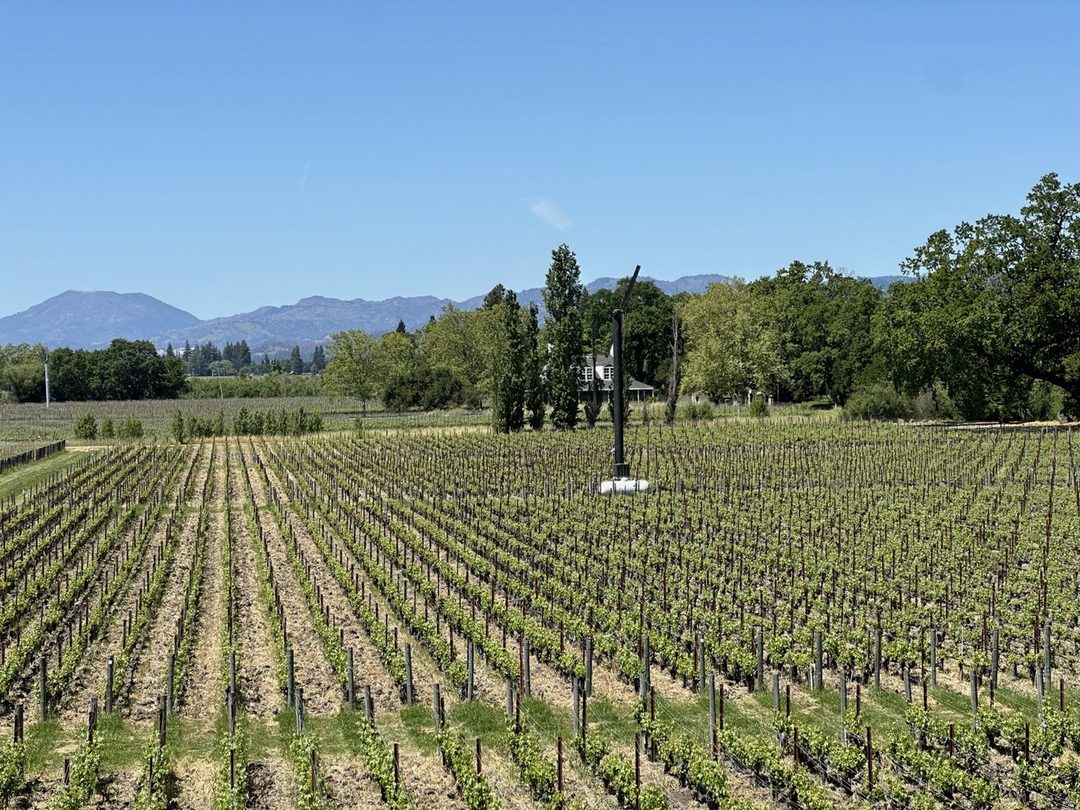
The winery sits on, and draws from, To Kalon: the Oakville vineyard first planted by Hamilton Crabb in the late 1860s and the most storied piece of Cabernet ground in the United States. In 1981 Robert Mondavi sold the venture 35 acres of it, the Q Block, and that parcel has been the backbone of the blend ever since. The estate later secured the neighbouring K Block of To Kalon on a long-term lease, and farms the Ballestra and River vineyards nearby.
To Kalon is not one owner’s vineyard. The Robert Mondavi Winery (now Constellation) holds the largest share and the trademark, Opus One holds its blocks, and Andy Beckstoffer, Napa’s best-known grower, owns 89 acres that he bought from Beaulieu in 1993 and sells under the “Beckstoffer To Kalon” name. He makes no wine himself.
Beckstoffer’s grapes are the priciest in Napa, and they are priced in a way no other vineyard has quite dared to copy. Rather than a flat price per ton, his contracts tie the cost of the fruit to the retail price of the finished wine: for years it was 100 times the bottle price per ton, and from around 2015 he raised the multiple to 175. A winery charging $200 a bottle therefore pays $35,000 a ton; the top producers, whose wines sell for $300 and up, pay more than $50,000. The open-market average for good Napa Cabernet at the time was about $5,800 a ton.
There are floors as well: a minimum price per ton, a minimum per acre to discourage severe crop-thinning, and a required minimum bottle price of $125 for any wine carrying his name. So the formula does more than set the cost of the grapes. It fixes the lowest price at which a Beckstoffer To Kalon wine can ever reach the shelf, and it is why you will not find one for less than about $150. Schrader, Paul Hobbs, TOR, Realm and Morlet have all built celebrated bottlings on exactly this arrangement.
Opus One’s fruit is its own, grown on the estate’s parcels, so none of this touches its costs directly. But it is worth knowing when you stand on the terrace looking north over the rows: this is some of the most valuable farmland in the world, valued vine by vine.
A Bordeaux idea, grown in Oakville
The winemaking philosophy has been Bordeaux from the first vintage, and it has never wavered. Opus One makes one wine: a blend of the five Médoc varieties, Cabernet Sauvignon leading, with Cabernet Franc, Merlot, Petit Verdot and Malbec in support, from the estate’s own vines, aged around eighteen months in new French oak and released on the first of October each year. The inaugural 1979 was even billed as “Napa Médoc” before cooler heads prevailed.
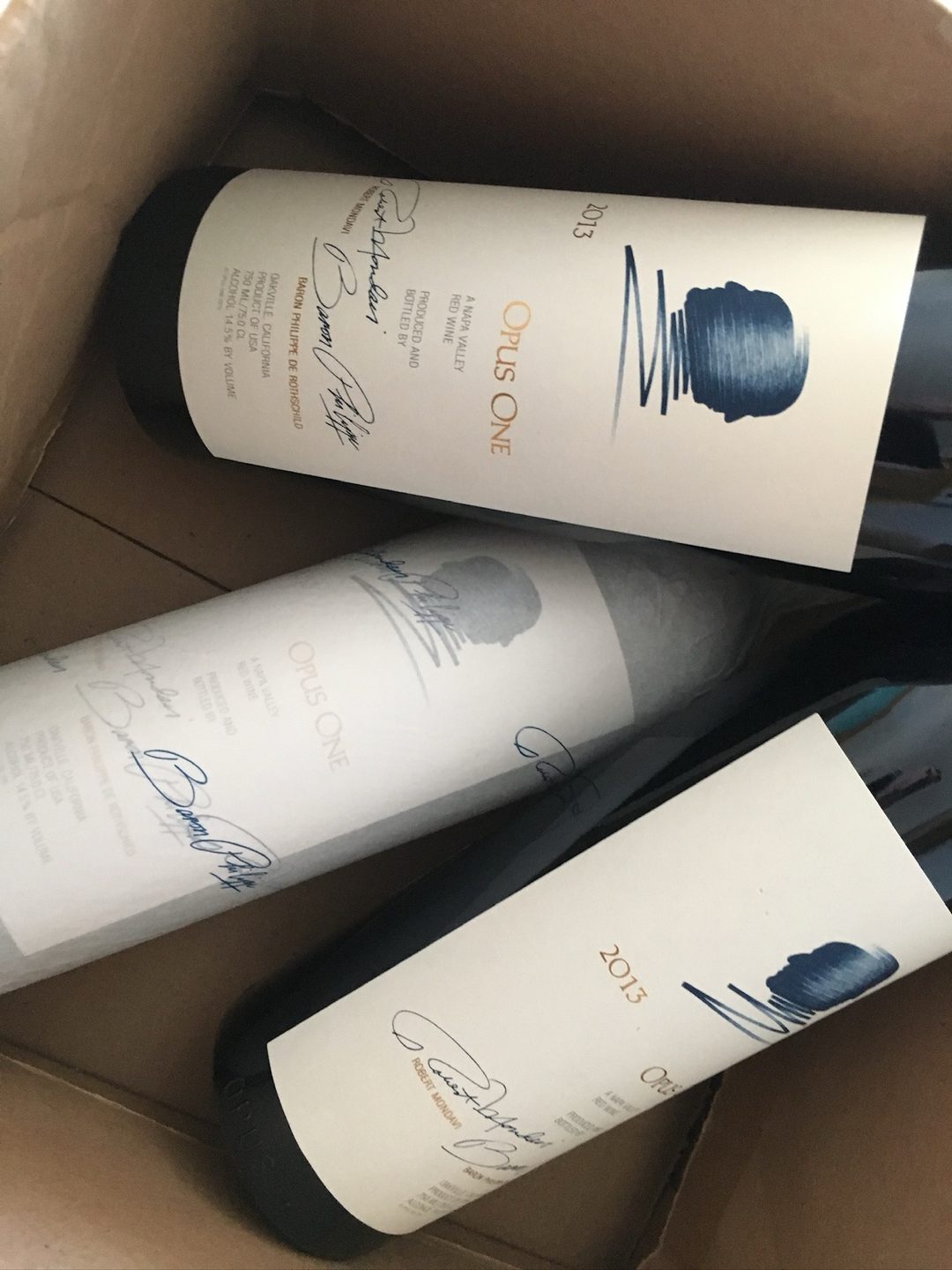
The connection runs through the commerce as well as the cellar. Outside the United States, Opus One is sold through the négociants of the Place de Bordeaux, the same system that allocates the classed growths, and the estate opened its own office in Bordeaux in 2012. For those of us who live here, there is a particular pleasure in finding a Napa wine on a négociant’s list, allocated and priced like a Pauillac.
The style, for all that, is unmistakably Oakville: ripe, polished and generous in fruit, but held together by the structure and restraint that the Rothschild side of the partnership always insisted upon. It is a wine that rewards a decade in the cellar and is a pleasure long before that, which was, from the beginning, precisely the point.
The property
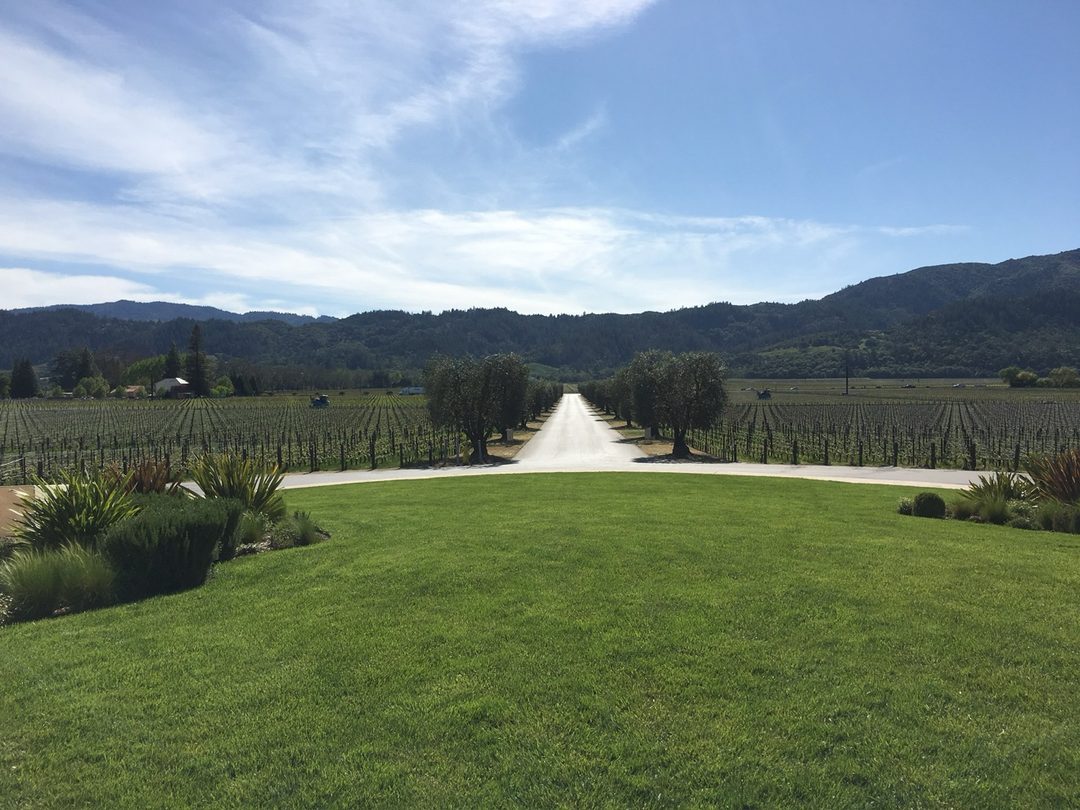
The building is one of the most beautiful in the valley, and much of its beauty lies in what it hides. Designed by Johnson Fain and inaugurated in 1991, the winery sits low behind a crescent-shaped berm planted with native grasses, so that from the drive you see a single pale curve of limestone rather than a building. The colonnade, the courtyard with its century-old olive trees and the hushed entrance hall give it the feel of a private house rather than a visitor centre.
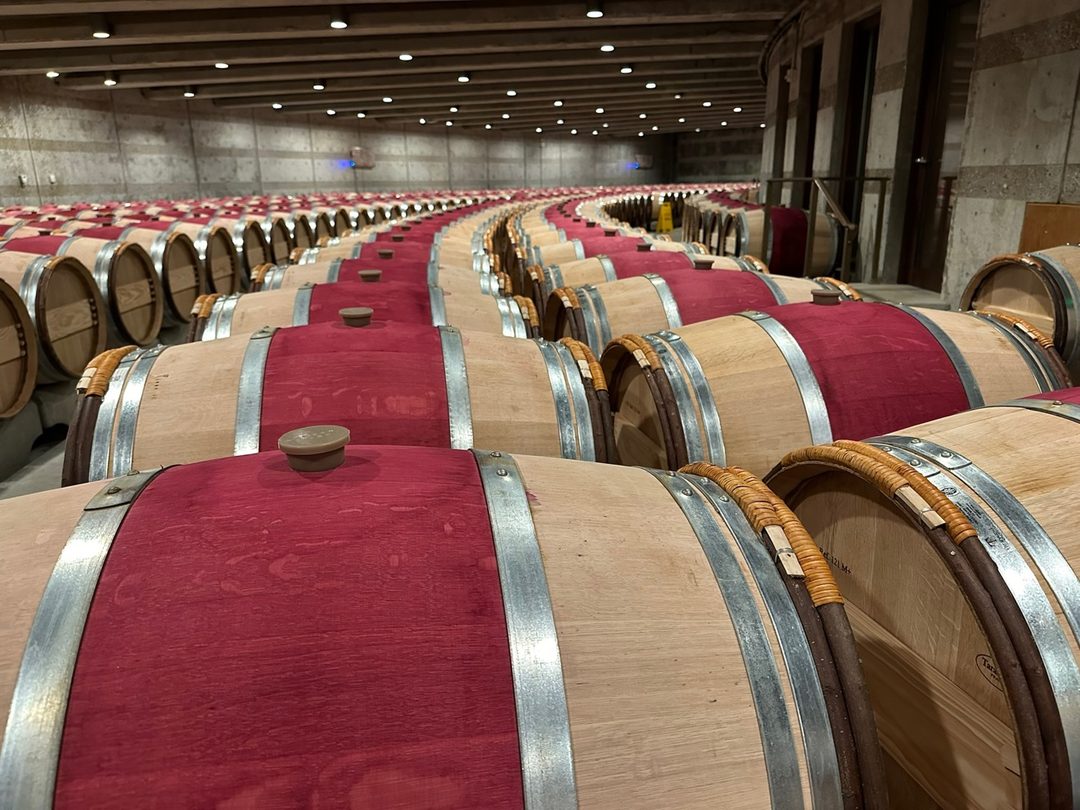
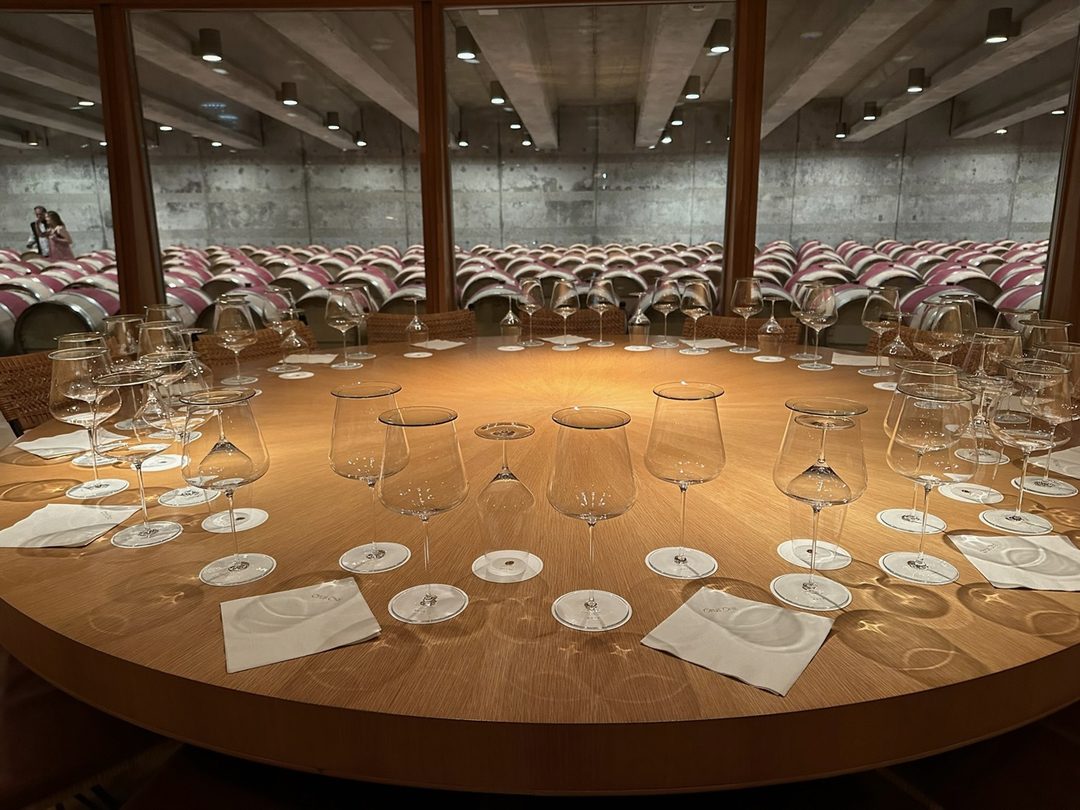
Beneath it all is the Grand Chai: a semi-circular barrel cellar, partly underground, that holds around a thousand French oak barriques in a single sweeping row, none stacked on another. A spiral staircase takes you down from the entrance hall and delivers you to the centre of the arc, with the barrels curving away on either side under low, warm light. It is the most photographed room at Opus One, and deservedly so.
May 2024: the new tasting room
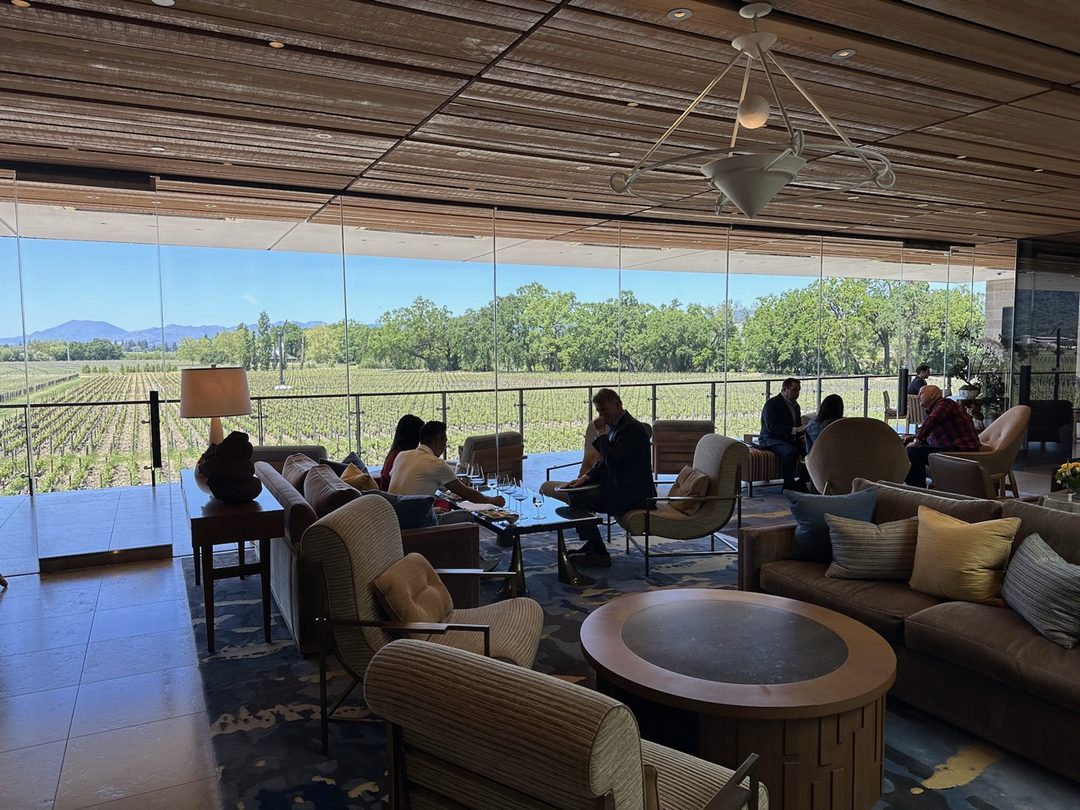
Our most recent visit, in May 2024, took in the new tasting room, the centrepiece of a large expansion of the winery by its original architects. The Partners’ Room sits on the upper level behind floor-to-ceiling glass, with limestone floors, walnut millwork and a rough-sawn hemlock ceiling that continues out over a terrace with a glass balustrade, so the estate vines and the northern valley run uninterrupted from your chair. It is furnished as a living room rather than a tasting bar, and hung with French and American art.
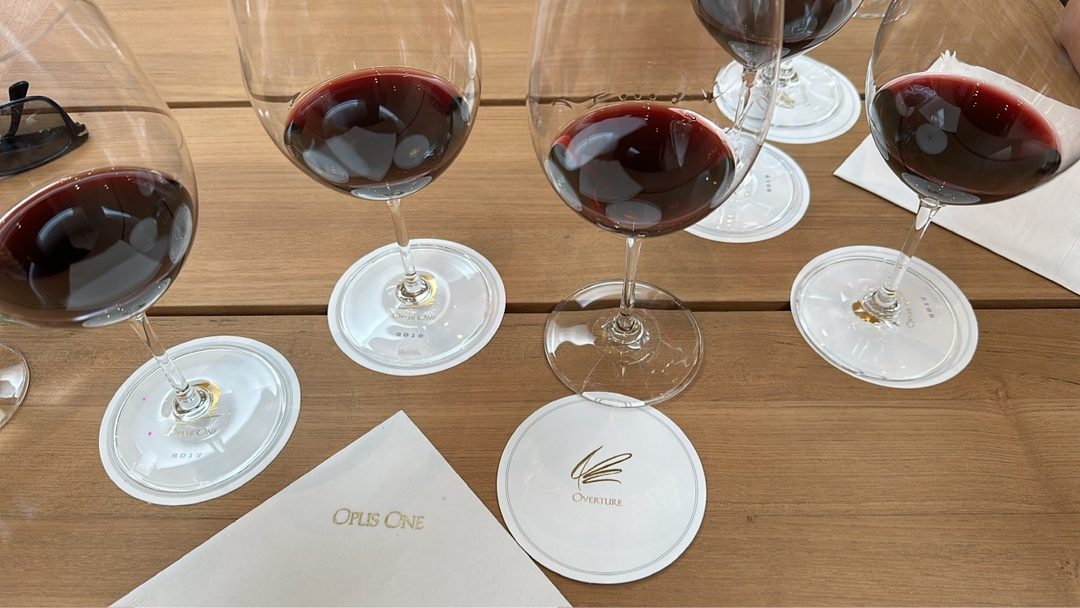
This is where the Opus One Experience is held. It runs around ninety minutes with a dedicated Estate Ambassador and begins with a guided tour of the winery, through the fermentation hall and down the spiral stair into the Grand Chai, before the tasting itself: the current vintage alongside two library vintages drawn from the estate’s collection. Tasting a young Opus One beside two older ones, with the vineyard that grew all three in view, is the most direct lesson in how this wine ages that we know of, and the ambassadors are generous with the stories behind each year.
The glassware, the pacing and the quiet are all exactly right. It is not an inexpensive hour and a half, and it is worth every minute.
The estate tasting, and Overture
On other visits we have simply popped in for the estate tasting: an hour in the Courtyard Tasting Room with the current vintage of Opus One and a glass of Overture, the estate’s second wine, looking out over the olive trees. It is the easier reservation to get and, for a first visit, the right one.
Overture is a more interesting wine to talk about than it first appears. Made since 1993 on the model of a Bordeaux second wine, it was for nearly three decades a multi-vintage assemblage: lots from across the estate, blended across two or more years, to make a softer, rounder wine that could be enjoyed on release. The last of those blends drew on the 2018 and 2019 harvests (no 2020 was made, after the fires), and with the 2021 vintage Overture carried a year on its label for the first time.
When we asked about the change, the answer was telling: the team wanted Overture to express the character of each growing season rather than hold a house style steady across many vintages. It is a quietly Bordelais decision, the vintage over the brand, and it says a good deal about how the estate thinks of itself.
If you go
Everything at Opus One is by appointment; there is no walk-in tasting bar, and every guest must be 21 or over, infants included. Reservations open two months ahead, released on the first day of each month, and the good slots go quickly. Online bookings are capped at four guests; larger parties go through the winery directly. Payment is taken at booking and becomes non-refundable 48 hours out (14 days for Art of the Table).
Opus One Estate Tasting: about 60 minutes, $150. Now pours two vintages of Opus One alongside Overture, and ends on the rooftop terrace. No tour.
Opus One Experience: about 90 minutes, $250. Guided tour, the current release and two library vintages in the Partners’ Room, with a small culinary accompaniment.
Art of the Table: about 2½ hours, $793. A four-course pairing with library vintages, weekdays only, four to eight guests, booked at least 14 days ahead.
The estate is open daily from 10am to 3.30pm, at 7900 St Helena Highway, Oakville, directly across the road from the Robert Mondavi Winery and about an hour and three-quarters from San Francisco airport. Prices and formats are as published in October 2026; we are happy to arrange the booking.
We will be back. We always are.
Sources
Opus One, Plan Your Visit (experiences, prices and booking rules, October 2026)
JancisRobinson.com, At what price, To Kalon? (Beckstoffer pricing formula)
Johnson Fain, Opus One Winery expansion (the Partners’ Room)
Decanter, Wine Legend: Opus One 1991 (history, To Kalon sale, the 1991 winery)
Wine.com, Overture 2023 winemaker notes (Overture becoming vintage-dated)